
There is a cholesterol-related number that can sit quietly in your blood for decades. You usually cannot feel it. Diet and exercise barely move it. And most people who have a high level have never been told the number exists.
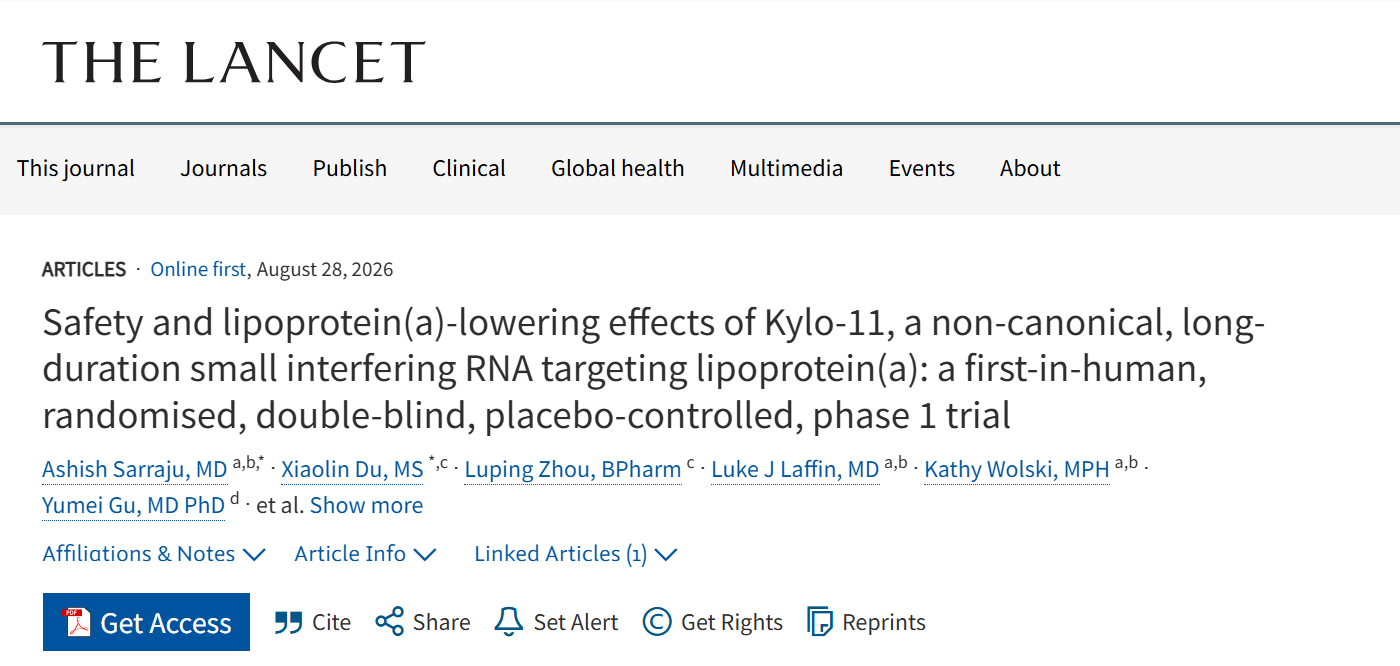
That number is lipoprotein(a) — written Lp(a), pronounced “L-P-little-a.” On August 28, 2026, a first-in-human Phase 1 trial of an investigational drug called Kylo-11 was published in The Lancet and presented as a late-breaker at ESC in Munich. One subcutaneous injection reduced Lp(a) by roughly half to nearly all — and at the highest doses, that drop held for about 48 weeks.
This is exciting Phase 1 science. It is not proof that Kylo-11 prevents heart attacks. Let me walk you through it the way I would with a patient in clinic.
What Lp(a) is — in plain language
Think of Lp(a) as LDL’s genetically stickier cousin. Like LDL (“bad cholesterol”), it is a particle that carries cholesterol in the blood. Because of its structure, elevated Lp(a) can contribute to plaque buildup in artery walls and tip clotting tendency — which is why cardiologists care about it as a heart-disease and stroke risk marker.
The key difference: about 80–90% of your Lp(a) level is inherited. Unlike LDL, lifestyle changes do not meaningfully lower Lp(a). Statins and diet can be powerful for other risk factors — and they still matter for overall heart health — but they are not a reliable dial for this one.
There is still no approved drug specifically designed to lower Lp(a). And Lp(a) remains under-tested. Many people with high levels simply do not know it.

What the study found
Kylo-11 is a long-acting small interfering RNA (siRNA). In simple terms, it is like a mute button for the liver’s Lp(a) factory. The drug delivers a gene-silencing signal to liver cells, reducing production of apo(a) — a building block of Lp(a). With less apo(a) made, the body assembles far fewer Lp(a) particles.
Design, in one breath:
- Phase 1 first-in-human, randomised, double-blind, placebo-controlled trial
- ~71 people enrolled in China; 70 received a dose (Kylo-11 or placebo)
- Single subcutaneous injection; follow-up on the order of ~48 weeks / ~11 months
- Lead author Ashish Sarraju, M.D. (Cleveland Clinic) and colleagues
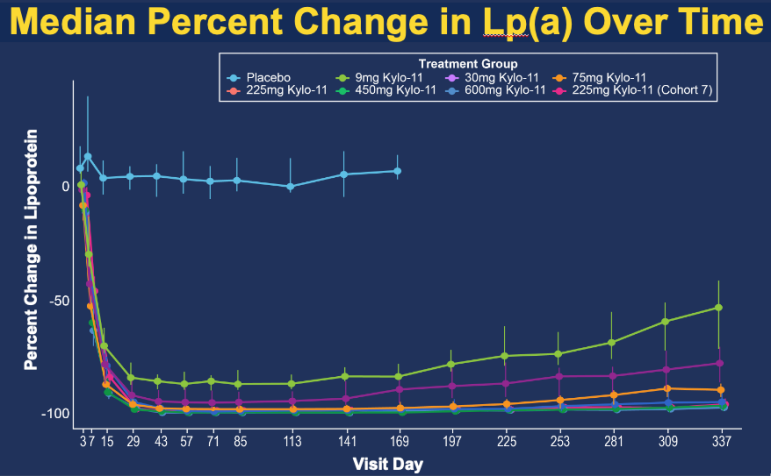
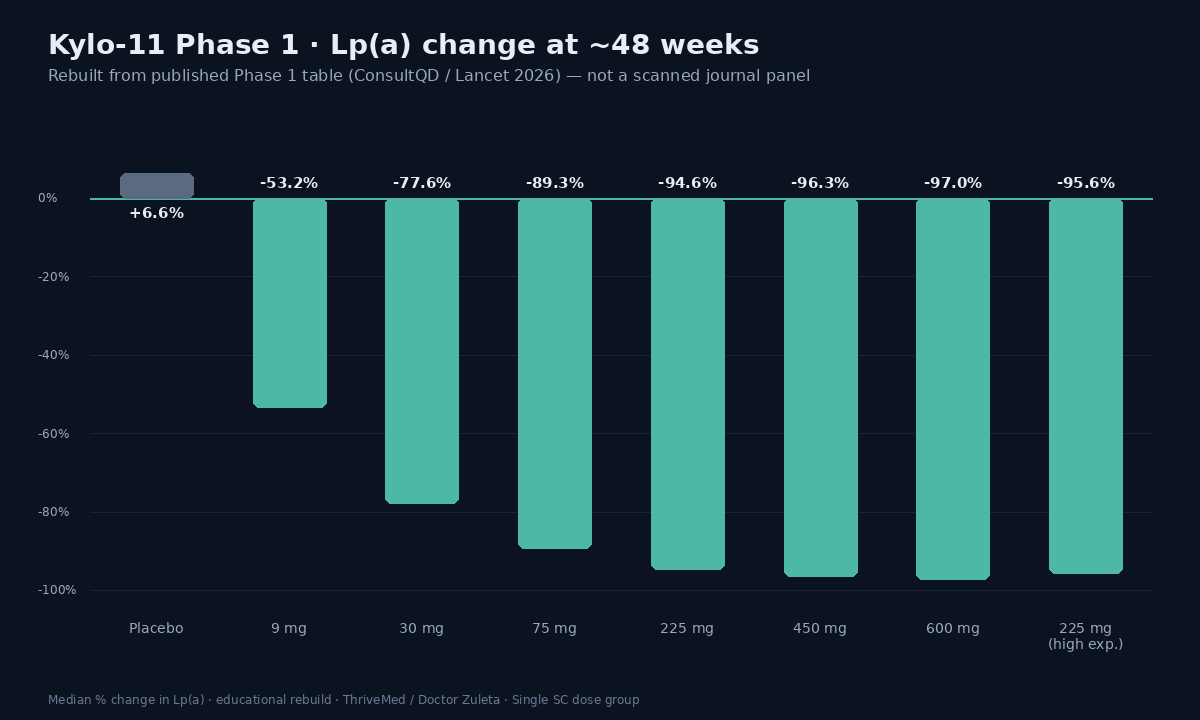
Results across dosing groups: a single injection reduced Lp(a) by approximately 53–97% at 48 weeks. Participants on the highest doses saw reductions of about 95–97%, with the effect sustained for nearly a year. Public coverage notes durable effect at doses ≥225 mg, with the 600 mg group showing a median reduction around 97%.

On safety: the drug was generally well tolerated in this Phase 1 experience. Coverage and the published findings summary report no serious drug-related adverse events in the trial as described.
Phase 1 answers safety and biomarker questions in a relatively small first-in-human study. It does not prove that Kylo-11 prevents heart attacks, strokes, or death. Kylo-11 is not approved and not available for routine clinical use. Cardiovascular outcome trials — and larger Phase 2/3 programs — are what tell us whether deep Lp(a) lowering changes events. A Phase 2 trial is already underway (sponsor: Kylonova Biopharma / Hygieia Pharma / SBP Group, collaborating with Cleveland Clinic investigators).
Excitement is fair. Overclaiming is not. A nearly year-long mute on an “untreatable” genetic risk marker is a meaningful signal. Converting that signal into fewer heart attacks is the next chapter — not this one.
What to ask your clinician
You do not need to wait for an investigational drug to act on the part you control today: knowing your number.
Bring these to your next visit
- “Can I get a lipoprotein(a) / Lp(a) blood test?” For most people it is a once-in-a-lifetime lab unless something clinical changes.
- “How does my Lp(a) fit with my overall risk?” Family history, LDL, blood pressure, diabetes, smoking, and inflammation still matter.
- “If my Lp(a) is high, what do we optimize now?” Aggressive management of other risk factors remains the practical playbook while Lp(a)-specific drugs are still in development.
- “Should we revisit this as Phase 2/3 data mature?” Reasonable to stay curious — without treating pipeline news as a prescription.
You can’t feel high Lp(a). You can’t diet it away. One blood test — often once in a lifetime — tells you where you stand. Ask for it. Bring the result to your clinician. Follow the science as Phase 2 unfolds — but do not wait for a drug to get tested.
Hi — if we haven’t met, I’m Doctor Zuleta. ThriveMed exists to expand human vitality. I write these research decodes to keep the claims honest and the next step clear. Stay curious. Stay vital.
Sources
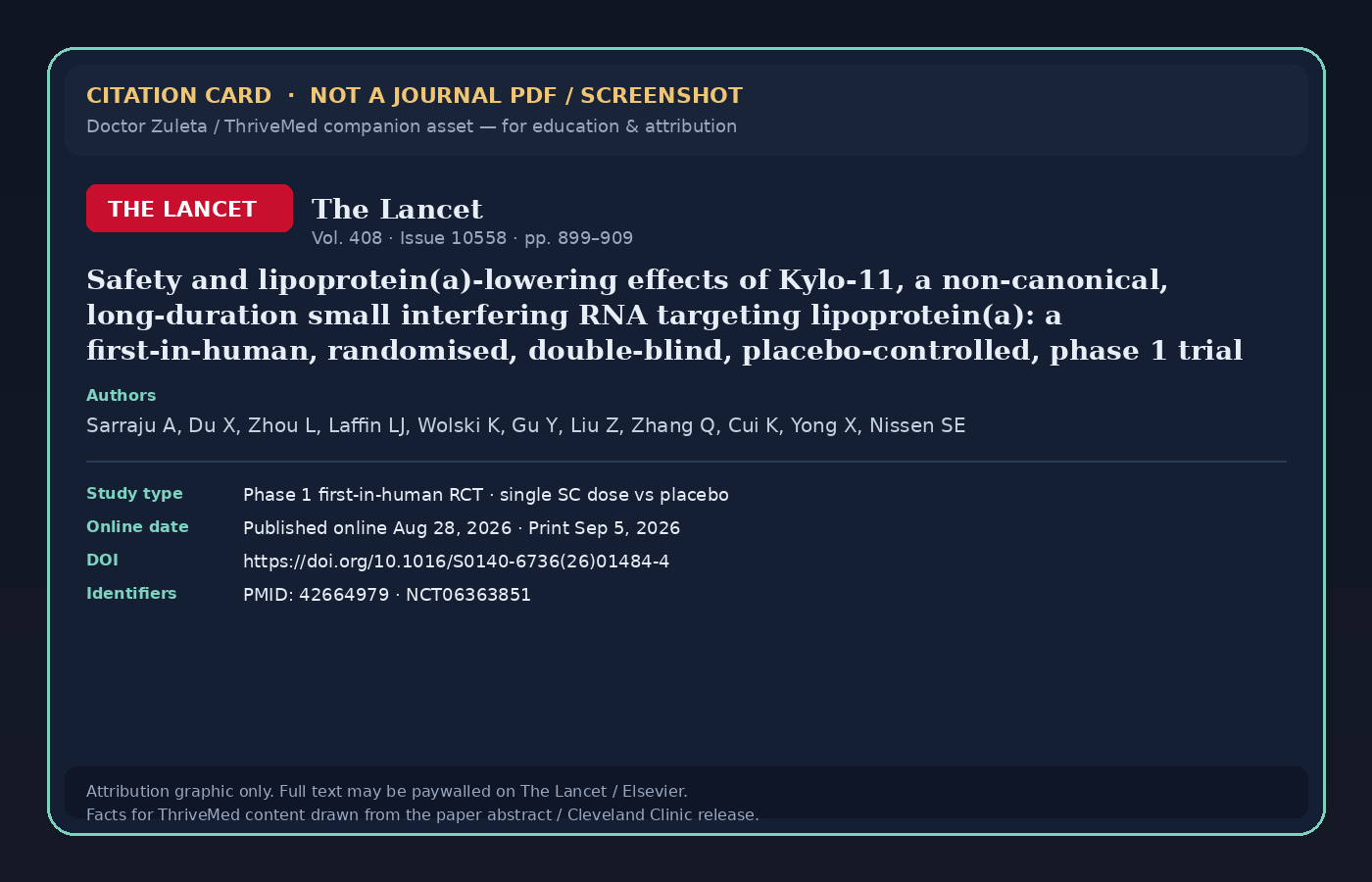
- Sarraju A, Du X, Zhou L, et al. Safety and lipoprotein(a)-lowering effects of Kylo-11… phase 1 trial. The Lancet. Online Aug 28, 2026; 408(10558):899–909. DOI: https://doi.org/10.1016/S0140-6736(26)01484-4 (PMID 42664979; ClinicalTrials.gov NCT06363851)
- Cleveland Clinic Newsroom. First in Human Long-Acting Gene Silencing Therapy Significantly Lowers Heart Disease Risk Marker with One Injection. Aug 28, 2026. newsroom.clevelandclinic.org/…
Educational content for ThriveMed / Doctor Zuleta. Not medical advice. Discuss testing and treatment decisions with your own clinician. Lp(a) illustration © Cleveland Clinic (newsroom media). Paper images on this page are ThriveMed citation cards, not reproduced journal PDFs.